

Why Self-Propelled Stretch Wrappers Are Replacing Traditional Turntable Wrappers
Release time: 2026-05-28
In the fast-paced world of modern logistics and warehousing, efficiency and adaptability are paramount. For decades, the traditional turntable wrapper has been the workhorse of end-of-line packaging, securing loads onto pallets for safe transit. However, as warehouses expand, product mixes become more complex, and labor shortages persist, a significant shift is occurring. The self-propelled pallet stretch wrapper is rapidly emerging as the preferred solution, gradually replacing its stationary predecessor. This transition is not merely a trend; it’s a strategic move driven by clear operational advantages. Let’s delve into why these mobile marvels are taking over.
The Limitations of Traditional Turntable Wrappers
To understand the rise of self-propelled machines, we must first examine the constraints of traditional turntable wrappers. These stationary units require pallets to be brought to them, typically via forklift or pallet jack.
- Space Constraints: Turntable wrappers occupy a fixed footprint. In congested facilities, dedicating permanent floor space to a wrapping station can be problematic.
- Bottlenecks: Because all loads must be transported to a central location, a bottleneck often forms during peak production periods. Forklift traffic increases around the wrapper, leading to delays and potential safety hazards.
- Unstable Loads: Very light, excessively heavy, or highly unstable loads can be problematic for turntables. The rotational force applied during wrapping can cause lightweight boxes to shift or unstable columns to topple before the film secures them.
- Oversized Pallets: Most turntables have a maximum load capacity. If a pallet exceeds this dimension, it simply cannot be wrapped on that machine.
The Rise of the Self-Propelled Pallet Stretch Wrapper
Enter the self-propelled pallet stretch wrapper, also known as a robotic or mobile stretch wrapper. Instead of bringing the load to the machine, the machine drives itself to the load. It navigates around the stationary pallet, applying stretch film with precision. This fundamental shift in operation addresses the core limitations of turntable models.
Unmatched Flexibility and Mobility
The most significant advantage of a mobile wrapper is its flexibility. It is not confined to a single location. Operators can drive the machine directly to the staging area, the end of a picking aisle, or even into a shipping container. This eliminates the need to double-handle loads, reducing forklift traffic and minimizing the risk of product damage during transit to a central wrapping station.
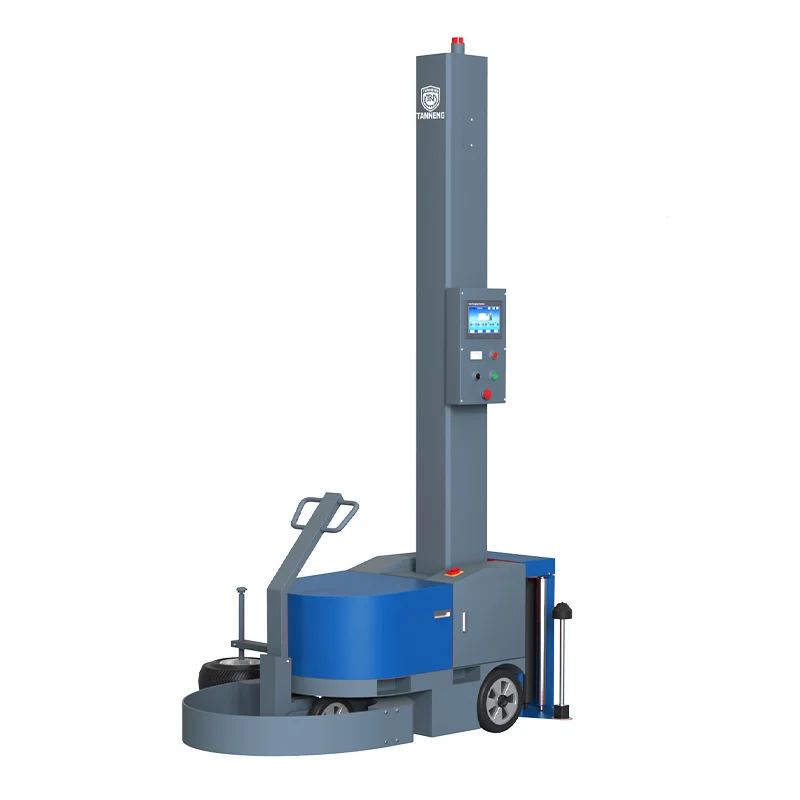
For facilities with multiple loading docks or fluctuating production layouts, this mobility is invaluable. An intelligent pallet wrapping system allows the wrapper to be deployed wherever it is needed most, maximizing asset utilization.
Handling Problematic Loads with Ease
Because the pallet remains stationary while the machine revolves around it, self-propelled wrappers excel at securing challenging loads.
- Lightweight Loads: Without the centrifugal force of a spinning turntable, delicate or lightweight products remain perfectly still during the wrapping process.
- Heavy and Unstable Loads: Exceptionally heavy pallets, which might strain a turntable motor, pose no problem for a mobile wrapper. Similarly, unstable loads that might collapse on a turntable can be gently and securely wrapped while resting safely on the floor.
- Oversized Loads: Self-propelled wrappers have virtually no limit on the length or width of the pallet they can wrap. As long as there is enough clearance for the machine to navigate around the perimeter, it can secure the load. This makes them ideal for industries handling oversized materials like construction supplies, large appliances, or custom machinery.
Maximizing Floor Space
By eliminating the need for a dedicated, permanent wrapping zone, facilities can reclaim valuable floor space. When not in use, the mobile wrapper can be parked out of the way. This is particularly beneficial for operations where square footage is at a premium.
Safety and Ergonomics
Reducing forklift traffic around a central wrapping station inherently improves warehouse safety. Fewer moving vehicles mean a lower risk of collisions and accidents. Furthermore, self-propelled machines often incorporate advanced safety features, such as collision avoidance sensors and emergency stop bumpers, ensuring safe operation even in busy environments.
Economic Advantages and ROI
While the initial investment in a self-propelled wrapper might be slightly higher than a basic turntable model, the long-term Return on Investment (ROI) is often superior.
| Feature | Turntable Wrapper | Self-Propelled Wrapper |
|---|---|---|
| Footprint | Fixed; requires dedicated space | Minimal, parks when not in use |
| Load Handling | Limited by weight and dimension | Virtually unlimited size/weight |
| Throughput | Prone to bottlenecks | Flexible, wraps at point of need |
| Labor Efficiency | Requires moving load to machine | Brings machine to the load |
The efficiency gains—reduced labor costs (less time spent transporting pallets), decreased product damage (fewer touches and stationary wrapping), and improved film yield (advanced pre-stretch carriages)—quickly offset the upfront cost.
Choosing a reputable automatic stretch wrapper manufacturer like TANNENG ensures that you are investing in a machine built for durability and optimized performance, further enhancing the ROI.
The Future of End-of-Line Packaging
The transition from stationary to mobile wrapping represents a broader trend towards flexible, decentralized automation in warehousing. As supply chains become more dynamic, the equipment supporting them must adapt.
The self-propelled wrapper is more than just a packaging machine; it’s a versatile tool that empowers operations to scale, pivot, and optimize their workflows. Whether it’s a standard stretch film wrapping machine or a highly advanced automatic stretch wrapping machine equipped with sophisticated controls, the shift towards mobility is undeniable.
The traditional turntable will likely always have a place in specific, high-volume, uniform-load applications. However, for the vast majority of modern warehouses dealing with diverse product mixes and spatial constraints, the self-propelled stretch wrapper offers a clearly superior solution, driving the future of secure, efficient pallet packaging. Partnering with forward-thinking companies like TANNENG ensures access to this cutting-edge technology, ready to meet the demands of tomorrow’s logistics landscape.
Frequently Asked Questions (FAQs)
1. How long does the battery last on a self-propelled stretch wrapper?
Battery life varies depending on the specific model, the frequency of use, and the height of the pallets being wrapped. However, most industrial-grade mobile wrappers are designed to operate for a full 8-hour shift, wrapping upwards of 150-200 pallets on a single charge. Many feature quick-charge capabilities or easily swappable battery packs to ensure continuous operation across multiple shifts.
2. Are self-propelled wrappers difficult to operate?
Not at all. Modern mobile wrappers are designed with user-friendliness in mind. They typically feature intuitive touch-screen interfaces, pre-programmable wrapping cycles (allowing operators to save specific settings for different load types), and simple joystick or handlebar controls for maneuvering the machine. Minimal training is required for an operator to become proficient.
3. What kind of maintenance does a mobile stretch wrapper require?
Maintenance is generally straightforward and comparable to other motorized warehouse equipment. Routine tasks include checking battery water levels (if applicable), inspecting the film carriage and pre-stretch rollers for wear and tear, keeping the sensors clean, and ensuring the drive wheels are free of debris. Regular preventative maintenance, often supported by the manufacturer, ensures optimal performance and a long lifespan for the machine.