

5 Step Guide to Choosing a Stretch Wrapper
Release time: 2026-06-11
Table of Contents
In today’s hyper-competitive global supply chain, securing your products for transit is no longer just a necessity; it is a critical driver of profitability. Whether you are shipping fragile electronics, heavy construction materials, or unstable food and beverage pallets, optimal load containment directly impacts your bottom line. Relying on manual labor for packaging can lead to inconsistent wrapping, high material waste, and an increased risk of product damage during transit.
Investing in the right packaging machinery can drastically reduce these risks, lower consumable costs, and boost overall warehouse productivity. However, navigating the vast array of available equipment can be daunting. This comprehensive 5-step guide to choosing a stretch wrapper will help you master the complexities of end-of-line packaging automation. If you are looking to upgrade your facility, partnering with an innovative manufacturer like TANNENG ensures you get reliable, high-performance wrapping solutions tailored to your precise operational needs.
Step 1: Analyze Your Load Profile and Characteristics
Before comparing machine specifications or requesting quotes, you must intimately understand the products you are wrapping. The weight, height, shape, and stability of your pallets dictate the fundamental architecture of the machine required. Industry experts typically categorize loads into A, B, and C profiles based on how uniform they are.
For extremely heavy, tall, or highly unstable loads (such as bottled liquids or fragile ceramics), rotary arm stretch wrappers are often the ideal choice. With these systems, the pallet remains completely stationary on the warehouse floor while the film carriage rotates around it, eliminating the risk of the load tipping over due to centrifugal force.
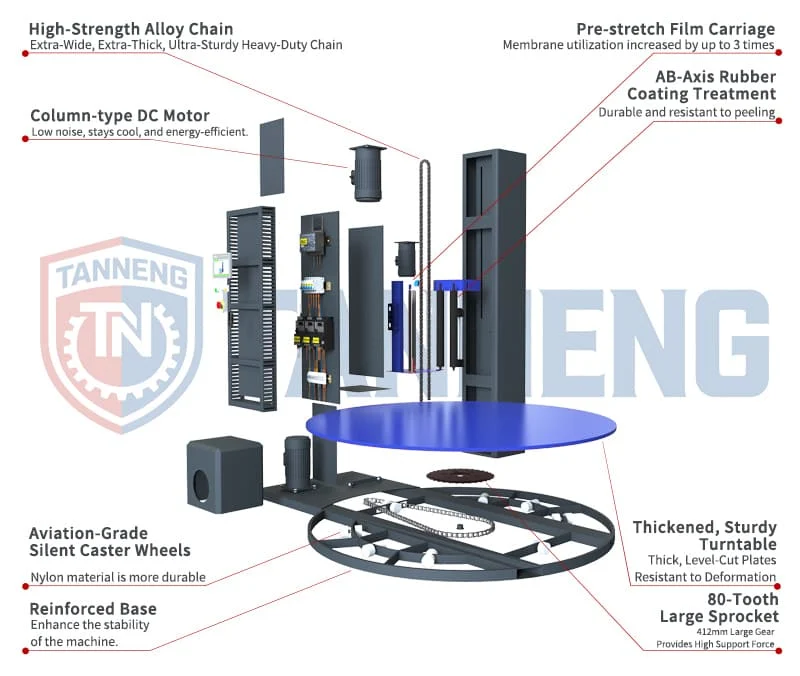
Conversely, standard, stable, and uniform loads are perfectly suited for traditional turntable stretch wrapping machines. Here, the pallet is placed on a rotating platform. You must carefully evaluate your maximum and minimum load dimensions to ensure the machine’s mast height and turntable diameter can accommodate your daily production without causing bottlenecks.
Step 2: Determine Volume and Throughput Requirements
How many pallets do you need to process per hour, per shift, or per day? Your throughput requirements will dictate whether your operation needs a low-volume manual assist, a mid-volume semi-automatic, or a high-speed fully automatic system.
Transitioning from manual hand-wrapping to semi-automatic pallet wrappers can increase your packaging efficiency by up to 50% while significantly reducing operator fatigue and workplace injuries. For high-volume distribution centers, e-commerce fulfillment hubs, or fast-moving consumer goods (FMCG) plants, fully automated stretch wrapping systems integrated directly into existing conveyor lines are absolutely essential. These systems cut the film, wipe the tail, and move the pallet down the line without any human intervention.
To help you visualize the best fit for your facility, refer to the comparison table below:
| Machine Type | Ideal Pallet Volume (Per Day) | Operator Involvement | Key Business Application Scenarios |
|---|---|---|---|
| Manual / Entry-Level | 1 – 15 Pallets | High (Attaches & cuts film manually) | Small warehouses, startup manufacturing, infrequent shipping. |
| Semi-Automatic | 15 – 50 Pallets | Medium (Forklift loading, button start) | Growing logistics centers, standard manufacturing plants. |
| Fully Automatic | 50 – 200+ Pallets | Zero (Fully integrated with conveyors) | High-throughput FMCG, large-scale distribution centers. |
Step 3: Evaluate Film Delivery and Pre-Stretch Capabilities
One of the most overlooked aspects of purchasing a pallet wrapping machine is the ongoing operational cost of consumables. The initial capital expenditure of the machine is a one-time event, but you will be purchasing plastic film for the lifespan of the equipment.
Advanced power pre-stretch carriages are designed to stretch the film significantly—often between 200% and 300%—before it is even applied to the load. This is achieved through a series of internal rollers running at different speeds. This technology maximizes the yield of every single roll, leading to massive stretch film consumption reduction. When evaluating your Return on Investment (ROI), factor in how much a modern, high-efficiency film carriage can save you in material costs over a three to five-year period. In many medium-to-high-volume operations, the film savings alone can pay for the entire machine within the first year.
Step 4: Assess Facility Space and Operating Environment
The physical footprint of the machine must fit safely and logically within your existing warehouse layout. Consider forklift traffic patterns, staging areas, and mandatory safety zones. If floor space is at an absolute premium, exploring alternative designs like mobile robot wrappers might provide the flexibility your layout demands.
Furthermore, consider your specific operating environment. Are you operating in a sub-zero cold storage facility, a dusty building materials plant, or a corrosive chemical washdown area? Ensure the equipment you select is engineered to withstand your specific conditions. Seeking out robust industrial stretch wrapping solutions that offer specialized modifications—such as anti-corrosion galvanized frames, sealed electrical cabinets, or cold-temperature lubricants—is crucial for maximizing equipment longevity and preventing unexpected downtime.
Step 5: Factor in Total Cost of Ownership and After-Sales Support
While the initial sticker price is a major factor, smart procurement professionals focus on the Total Cost of Ownership (TCO). TCO encompasses the purchase price, routine maintenance, spare parts availability, energy consumption, and long-term film usage. Buying the cheapest machine on the market often leads to higher maintenance costs and crippling operational downtime.
Choosing a reputable and established brand ensures you receive timely technical support, clear documentation, and easily accessible replacement parts. A trusted industry partner like TANNENG provides comprehensive after-sales service and engineering excellence, ensuring your stretch film packaging equipment operates at peak performance for years to come. Look for suppliers who offer preventative maintenance schedules, operator training, and transparent warranty terms.
Conclusion
Selecting the perfect load containment equipment does not have to be an overwhelming process. By systematically assessing your unique load characteristics, throughput volume, facility space, film efficiency potential, and long-term operating costs, you can make a highly informed decision that drives operational excellence. Remember that the right pallet wrapper is not just a cost center; it is a strategic investment in product safety, brand reputation, and labor efficiency. As you evaluate your options in the market, TANNENG stands ready to provide cutting-edge, reliable systems designed to protect your valuable goods and optimize your entire packaging line.
Frequently Asked Questions (FAQs)
Q1: At what volume should my business upgrade from manual hand-wrapping to a machine?
A: The general industry rule of thumb is that if your facility is wrapping more than 10 to 15 pallets per day, you should invest in a machine. Beyond this threshold, manual wrapping becomes highly inefficient, leads to inconsistent load containment, and significantly increases the risk of repetitive strain injuries for your workers.
Q2: What is the main difference between a turntable and a rotary arm stretch wrapper?
A: The primary difference lies in how the load is handled. On a turntable wrapper, the pallet is placed on a spinning platform while the film carriage moves up and down. On a rotary arm wrapper, the pallet remains completely stationary on the floor while a mechanical arm rapidly rotates the film around it. Rotary arms are generally preferred for extremely heavy, light, or unstable loads that might fall apart if spun on a turntable.
Q3: How much money can I really save with a power pre-stretch carriage?
A: The savings can be substantial. Traditional wrapping or basic friction-brake machines typically stretch film by 10% to 20%. A power pre-stretch carriage can stretch the same film by 200% to 300%. This means a 1-meter length of film off the roll can cover 3 to 4 meters of your pallet. Depending on your volume, businesses often see a reduction in film costs of 40% to 60%, resulting in thousands of dollars saved annually.