

Self-Propelled Stretch Wrapper vs. In-Line Wrapping Machine: Which Layout Fits Your Variable-Throughput Production Line
Release time: 2026-09-18
Table of Contents
For manufacturers handling changing order volumes, mixed pallet sizes, or multiple production areas, the wrapping machine layout can significantly affect labor efficiency, line balance, floor-space utilization, and load stability. The choice between a self-propelled stretch wrapper and an in-line wrapping machine should therefore be based on the entire production workflow rather than machine speed alone.
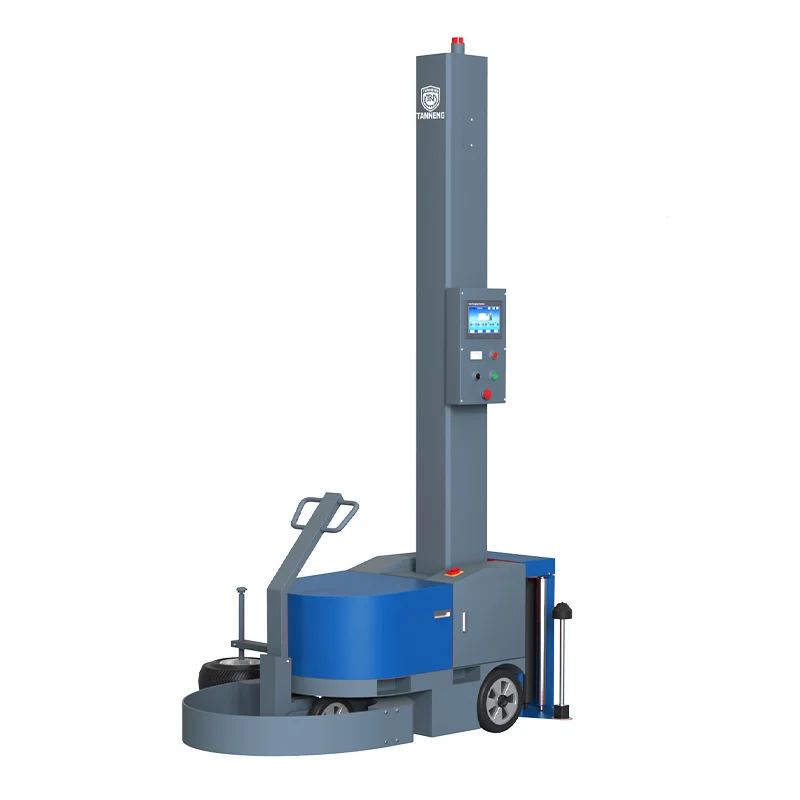
A mobile wrapper travels around a stationary pallet, while an in-line system is installed within a fixed conveyor-based packaging line. Both solutions can improve wrapping consistency, but they are designed for different operating conditions.
Understanding the Two Wrapping Layouts
A self-propelled stretch wrapper is a mobile pallet wrapping system that moves around a stationary load. The machine is positioned near the pallet, and its powered drive system allows it to travel around the load while applying stretch film.
This layout is commonly considered for facilities where:
- Pallets are completed at different production locations.
- Pallet sizes and load shapes vary.
- Production volume changes by shift, season, or customer order.
- Existing conveyors are limited.
- The facility layout may change in the future.
- Large or heavy loads are difficult to move to a fixed wrapping station.
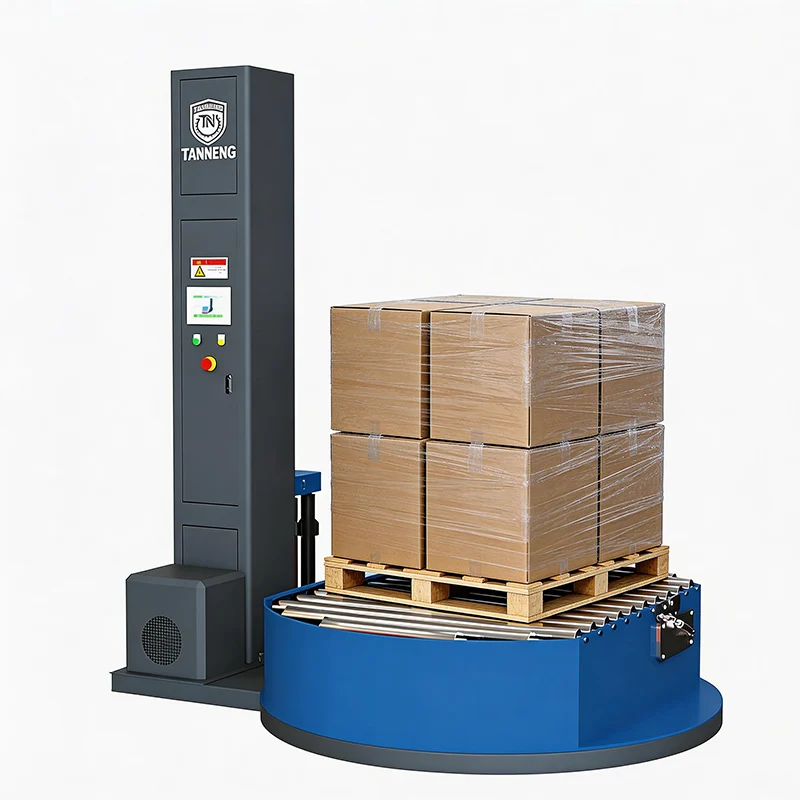
An in-line wrapping machine, by contrast, is installed as part of a conveyor-based packaging process. Pallets are transferred into the wrapping area, wrapped automatically, and then moved to the next stage, such as labeling, strapping, storage, or shipment.
An in-line system may include conveyors, pallet sensors, automatic film cutting, load-positioning equipment, safety guarding, and communication with upstream or downstream machinery. It is generally designed for repeatable product flow and standardized pallet handling.
The Main Difference: Mobility or Integration?
The most important difference is how the machine interacts with the production line.
| Evaluation factor | Self-propelled stretch wrapper | In-line wrapping machine |
|---|---|---|
| Basic layout | Mobile equipment travels to the load | Fixed equipment receives the load |
| Pallet handling | Pallet usually remains stationary | Pallet moves through the wrapping station |
| Best operating environment | Multiple wrapping points and changing workflows | Stable conveyor-based production |
| Pallet variation | Suitable for a broad range of load sizes | Best when pallet specifications are controlled |
| Installation requirement | Limited changes to the existing facility | Requires conveyor and control-system integration |
| Operator involvement | Usually moderate | Generally low after commissioning |
| Throughput consistency | Depends on positioning and operating conditions | Highly consistent in a balanced production line |
| Relocation | Relatively easy | Difficult and potentially expensive |
| Automation potential | Semi-automatic to highly automated | Usually fully automatic |
| Infrastructure investment | Lower in many applications | Higher because of integration requirements |
Neither layout is suitable for every factory. A mobile wrapper emphasizes adaptability, while an in-line system emphasizes continuous material flow and synchronized automation.
Throughput Considerations
Variable throughput makes machine selection more complex. The key question is not simply how many pallets a machine can wrap under ideal conditions. Buyers should also consider how consistently pallets arrive, how frequently products change, and how much operator involvement is required between cycles.
A basic capacity calculation is:
Required wrapping capacity=Available wrapping hours per shiftPallets per shift
Available wrapping hours should exclude breaks, product changeovers, film replacement, routine maintenance, pallet accumulation, and other interruptions.
For example, a factory may produce 240 pallets during an eight-hour shift. If only seven hours are available for wrapping after breaks and changeovers, the required average capacity is approximately 34 pallets per hour. However, the actual machine requirement may be higher if pallets arrive in batches or if wrapping demand increases during certain periods.
A self-propelled unit can be useful when production is irregular. It can serve different areas and process pallets as they become available. An in-line system is normally more effective when pallets arrive continuously and the wrapping station must keep pace with a conveyorized line.
Rated speed should therefore be compared with actual cycle time, pallet dimensions, wrapping height, film type, number of film layers, and load-containment requirements.
Advantages of a Self-Propelled Stretch Wrapper
Flexible wrapping locations
A mobile machine can serve more than one production area. This is valuable for factories that manufacture several product categories or operate multiple short production lines.
Adaptability to mixed pallets
When pallet dimensions and load heights vary significantly, a mobile layout may be easier to manage. The operator can position the machine around the load without redesigning the conveyor path for every product type.
Lower layout disruption
A self-propelled wrapper can often be introduced without installing a complete conveyor system. This makes it suitable for facilities that want to improve wrapping consistency while preserving the existing material-handling process.
Support for changing production volumes
The machine can be moved to the area with the highest demand. During seasonal peaks, it may support a temporary production cell, warehouse zone, or overflow operation.
Easier future relocation
If the plant changes its layout, a mobile machine can generally be reassigned with less disruption than a fixed wrapping station.
The main limitation is that the system still depends on effective operator procedures. Staff may need to position the machine, attach the film, select the wrapping program, check the load, and manage battery charging. Clear travel paths and proper pallet placement are also necessary for safe and efficient operation.
Advantages of an In-Line Wrapping Machine
Consistent production flow
An in-line machine can wrap pallets automatically as they move through the packaging line. This can reduce waiting time and help maintain a predictable end-of-line rhythm.
Reduced manual handling
Automatic conveying, film application, cutting, and sealing can reduce the number of manual steps. This may improve consistency and reduce the effects of operator fatigue.
Suitable for standardized pallets
In-line systems perform particularly well when pallet dimensions, load heights, weights, and wrapping requirements remain within a defined range. Standardized inputs make machine programming and quality control easier.
Easier connection with other equipment
An in-line wrapping machine can be integrated with palletizers, conveyors, case packing equipment, strapping systems, labelers, robotic handling units, and warehouse systems.
Better process monitoring
A fixed system can be connected to a central control system. Depending on the configuration, manufacturers may monitor pallet counts, alarms, cycle times, film usage, production recipes, and maintenance conditions.
The main disadvantage is reduced flexibility. Changes to pallet sizes, conveyor direction, product mix, or production capacity may require mechanical, electrical, or software modifications.
Which Layout Fits Variable Throughput?
The following questions can help identify the more suitable layout.
Is pallet flow continuous?
If pallets arrive continuously from a palletizer or conveyor, an in-line system may provide better synchronization. If pallets are produced intermittently or in separate areas, a self-propelled wrapper may provide greater practical flexibility.
How much do pallet dimensions vary?
A broad range of pallet sizes and load shapes usually favors a mobile solution. A fixed system may still handle multiple formats, but the full operating range must be confirmed before installation.
Are there several wrapping points?
If pallets require wrapping in different departments, moving one machine between locations may be more economical than installing several fixed systems. If all pallets pass through one central end-of-line area, an in-line system may be more efficient.
Is the factory layout stable?
A stable facility with long-term production planning is more suitable for fixed integration. A growing or frequently changing operation may benefit from mobile equipment that can be redeployed.
What level of automation is required?
If the goal is to minimize operator involvement and connect wrapping with other packaging equipment, an in-line machine is generally the stronger option. If the priority is reducing manual film application while keeping the existing workflow, a self-propelled wrapper may be sufficient.
How important is redundancy?
A factory that cannot tolerate wrapping downtime may use a mobile unit as a backup for a fixed system. In other cases, a mobile machine can provide temporary capacity during maintenance or seasonal demand increases.
Technical Factors to Compare
Whether the selected system is mobile or fixed, the following specifications should be reviewed carefully:
- Minimum and maximum pallet dimensions.
- Maximum load weight.
- Maximum wrapping height.
- Film width and thickness.
- Pre-stretch ratio.
- Film tension and containment-force control.
- Wrapping speed and actual cycle time.
- Number of available wrapping programs.
- Automatic film cutting and sealing.
- Battery capacity for mobile equipment.
- Conveyor height and pallet-transfer conditions.
- Safety sensors, guarding, and emergency-stop functions.
- PLC and HMI compatibility.
- Communication with upstream and downstream equipment.
- Maintenance access.
- Spare-parts availability.
- Electrical standards for the target market.
Film selection also affects wrapping performance. A faster machine does not necessarily produce a more secure load if the film type, tension, pre-stretch, or wrapping pattern is unsuitable for the product. The machine and film should be evaluated together with pallet stability, product shape, transport conditions, and storage requirements.
A Hybrid Approach
Some factories may benefit from using both layouts. A fixed in-line system can handle standardized pallets from the main high-volume production line, while a self-propelled wrapper can process mixed pallets, secondary products, overflow volume, or loads from other departments.
This approach can provide additional flexibility and operational backup. It may be particularly useful when a company has one predictable production flow and another area with irregular or seasonal demand.
However, a hybrid system also requires separate operating procedures, maintenance planning, training, and spare-parts management. It should be evaluated according to the expected reduction in downtime, labor requirements, and production bottlenecks.
Final Decision
A self-propelled stretch wrapper is usually a better fit when production locations, pallet formats, and daily workloads change frequently. It offers mobility and can improve wrapping consistency without requiring a major conveyor installation.
An in-line wrapping machine is generally more appropriate for stable, high-volume production lines with standardized pallets and a clear need for continuous automatic operation. It can provide predictable cycle times and integrate with other end-of-line equipment.
For manufacturers with uncertain growth or mixed production requirements, a phased or hybrid strategy may be practical. The final decision should be based on actual pallet flow, peak throughput, product variation, available floor space, labor conditions, and future expansion plans.
TANNENG provides pallet wrapping equipment for different industrial packaging environments. Its solutions can be considered according to production layout, pallet specifications, throughput requirements, and the desired level of automation.