


How Do Standard Stretch Wrap Machines Work?
Release time: 2026-07-16
Conclusion: Standard stretch wrap machines work by mechanically rotating a palletized load while precisely dispensing and overlapping a continuous layer of plastic film around it to secure the items. They provide essential structural stability, environmental sealing (against dust and moisture), and vital load containment for warehouse logistics. Without robust automated wrapping equipment, distribution centers would suffer from severe shipping bottlenecks, safety hazards, and damaged goods. Data shows that upgrading to an automated stretch wrapper reduces film material waste by up to 50% in high-volume industrial settings and decreases transit damage rates by over 60% compared to manual, inconsistent hand-wrapping methods.
In this guide, we’ll dive deep into the mechanics, components, and operational flow of these essential machines. Whether you are looking to upgrade from manual wrapping or simply curious about the mechanics, understanding the inner workings of a standard pallet wrapper is crucial for optimizing your packaging line.
The Basic Principle: Securing the Load
At its core, the goal of a stretch wrap machine is simple: to apply a continuous, tight layer of stretch film around a palletized load. This process binds the individual items together, creating a unified, stable unit that is resistant to shifting during transit, protected from dust and moisture, and much easier to handle with a forklift or pallet jack.
While manual wrapping requires a worker to physically walk around the pallet, unrolling and pulling the film tight, an automated pallet stretch wrapper streamlines this entire process, ensuring consistent tension and optimal film usage.
Key Components of a Standard Stretch Wrap Machine
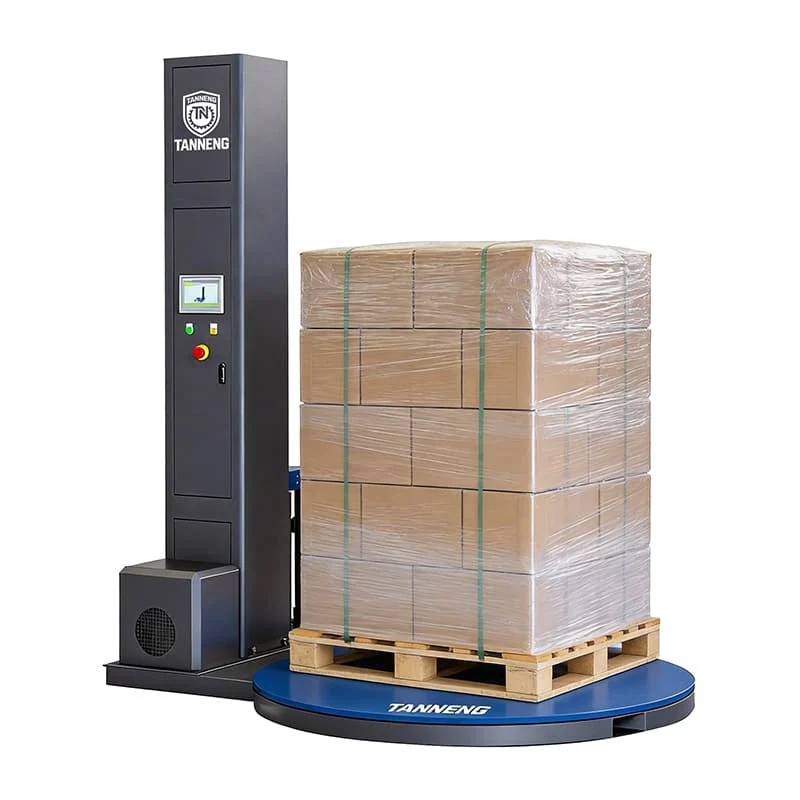
To understand how the machine works, we first need to identify its primary components. Most standard turntable machines share a similar architecture:
- The Turntable: This is the rotating platform where the pallet is placed. Depending on the model, it can be a low-profile turntable (accessed via a ramp for pallet jacks) or a high-profile turntable (designed for forklift loading). The turntable’s rotation speed is usually adjustable.
- The Mast (or Column): This vertical structure stands adjacent to the turntable. It supports and guides the film carriage as it moves up and down during the wrapping cycle.
- The Film Carriage: This is arguably the most critical component. It holds the roll of stretch film and travels vertically along the mast. Crucially, the carriage is responsible for dispensing the film and controlling its tension.
- The Control Panel: The brain of the machine. Operators use this interface to adjust settings such as turntable speed, carriage speed, film tension, and the number of top and bottom wraps. Modern machines often feature programmable logic controllers (PLCs) with pre-set wrapping recipes.

The Wrapping Process: Step-by-Step
Let’s walk through a typical cycle of a semi-automatic turntable stretch wrapper, the most common type used in many facilities.
Step 1: Loading and Preparation
The process begins by placing the loaded pallet onto the center of the turntable. Ensuring the load is relatively centered is important for stability during rotation. Once in place, the operator pulls the loose end of the stretch film from the carriage and attaches it securely to the base of the pallet or one of the items on the load.
Step 2: The Wrapping Cycle Initiates
The operator starts the cycle via the control panel. The turntable begins to rotate slowly at first, gradually increasing to the set speed. Simultaneously, the film carriage begins dispensing film.
Step 3: Bottom Wraps for Stability
The carriage remains at the bottom of the mast for a predetermined number of rotations. These initial bottom wraps are vital. They anchor the load to the pallet itself, ensuring that if the pallet tilts during transport, the load doesn’t slide off.
Step 4: The Upward Ascent
Once the bottom wraps are complete, the carriage begins its ascent up the mast while the turntable continues to rotate. The combination of horizontal rotation and vertical movement creates a helical, overlapping pattern of film around the load. The speed of the carriage relative to the turntable dictates the amount of film overlap.
Step 5: Top Wraps and Overwrap
When the carriage reaches the top of the load (often detected by a photo-eye sensor), it stops ascending. It remains at the top for a set number of rotations to secure the upper tiers of the load. In many cases, the carriage will go slightly above the load to create an “overwrap,” which helps pull the top boxes downwards, further increasing stability.
Step 6: The Descent and Cycle Completion
After the top wraps, the carriage descends back down the mast, adding another layer of overlapping film. Once it reaches the bottom, the turntable slowly decelerates and stops. The operator then cuts the film and smooths the tail against the wrapped load. The pallet is now ready to be moved.
Understanding Film Delivery Systems: The Core Difference
How the film carriage dispenses the film is the most significant differentiator among standard machines. There are two primary types of film delivery systems:
1. Mechanical Tension (or Friction) Wrappers
In a mechanical tension system, the film is stretched simply by creating drag on the film roll as it’s pulled by the rotating load. This is often achieved via a mechanical brake.
- How it works: As the pallet turns, it pulls the film. The brake resists this pull, causing the film to stretch between the carriage and the load.
- Pros: Simpler design, generally less expensive upfront.
- Cons: Inconsistent tension (especially on irregular loads), higher film consumption, and a higher risk of load damage if the tension is set too high for fragile items. The “stretch” occurs after the film leaves the carriage.
2. Pre-Stretch Delivery Systems
This is the standard for modern, efficient operations. A pre-stretch pallet wrapping machine utilizes powered rollers within the film carriage to stretch the film before it is applied to the load.
- How it works: The carriage contains two motorized rollers. The second roller turns faster than the first. As the film passes between them, it is stretched significantly (often by 200% to 300% or more). This stretched film is then applied to the load with a secondary, usually lighter, tension.
- Pros: Substantial film savings (reducing material costs significantly), consistent tension regardless of load shape, stronger holding force (due to the “memory” of the stretched film trying to contract), and safer for crushing-sensitive products.
Comparing Film Delivery Mechanisms
| Feature | Mechanical Tension | Powered Pre-Stretch |
|---|---|---|
| Film Stretch Mechanism | Friction brake on the film roll | Motorized rollers within the carriage |
| Where Stretching Occurs | Between carriage and load | Inside the carriage, before application |
| Stretch Capacity | Low (typically under 100%) | High (200% – 300%+) |
| Film Yield / Cost | Low yield / Higher long-term cost | High yield / Lower long-term cost |
| Load Holding Force | Variable, can be inconsistent | Consistent, high retention force |
| Ideal For | Very low volume, heavy/solid loads | Medium to high volume, most load types |
Why the Mechanics Matter for Your Business
Understanding how a standard stretch wrap machine works isn’t just about mechanics; it’s about business efficiency. A well-chosen machine directly impacts your bottom line.
- Labor Efficiency: Replacing manual wrapping with an automated system frees up valuable employee time for other tasks and reduces the risk of repetitive strain injuries.
- Material Savings: While a pre-stretch pallet wrapping machine requires a higher initial investment than a friction model, the drastic reduction in film consumption often results in a rapid return on investment.
- Load Integrity: The ultimate goal is ensuring your product arrives at its destination in the exact condition it left your facility. Consistent, mechanical wrapping minimizes shifting and damage during transit, reducing costly returns and unhappy customers.
If you are evaluating packaging solutions for your warehouse, companies like TANNENG offer a range of standard and specialized wrapping machines designed to integrate seamlessly into diverse production environments. Selecting the right equipment depends heavily on your specific throughput, load types, and long-term operational goals.
Frequently Asked Questions (FAQ)
1. What is the difference between a semi-automatic and an automatic standard pallet wrapper?
A semi-automatic wrapper requires an operator to place the pallet, attach the film, start the machine, and cut the film at the end. An automatic machine requires no operator intervention during the wrapping cycle; it feeds the film, wraps, cuts, and seals the tail automatically, usually integrating into a conveyor system.
2. How do I know if I need a machine with a pre-stretch carriage?
If you are wrapping more than 15-20 pallets per day, a pre-stretch machine is almost always the more economical choice. The savings in stretch film costs will quickly offset the higher purchase price of the equipment compared to a standard friction-brake model.
3. Can standard stretch wrap machines handle irregularly shaped loads?
Yes, but the effectiveness depends on the machine’s features. Machines equipped with advanced load-sensing technology (like photo-eyes) and pre-stretch carriages are much better equipped to handle inconsistent profiles and fragile loads without crushing the product or tearing the film.

